 Course Kit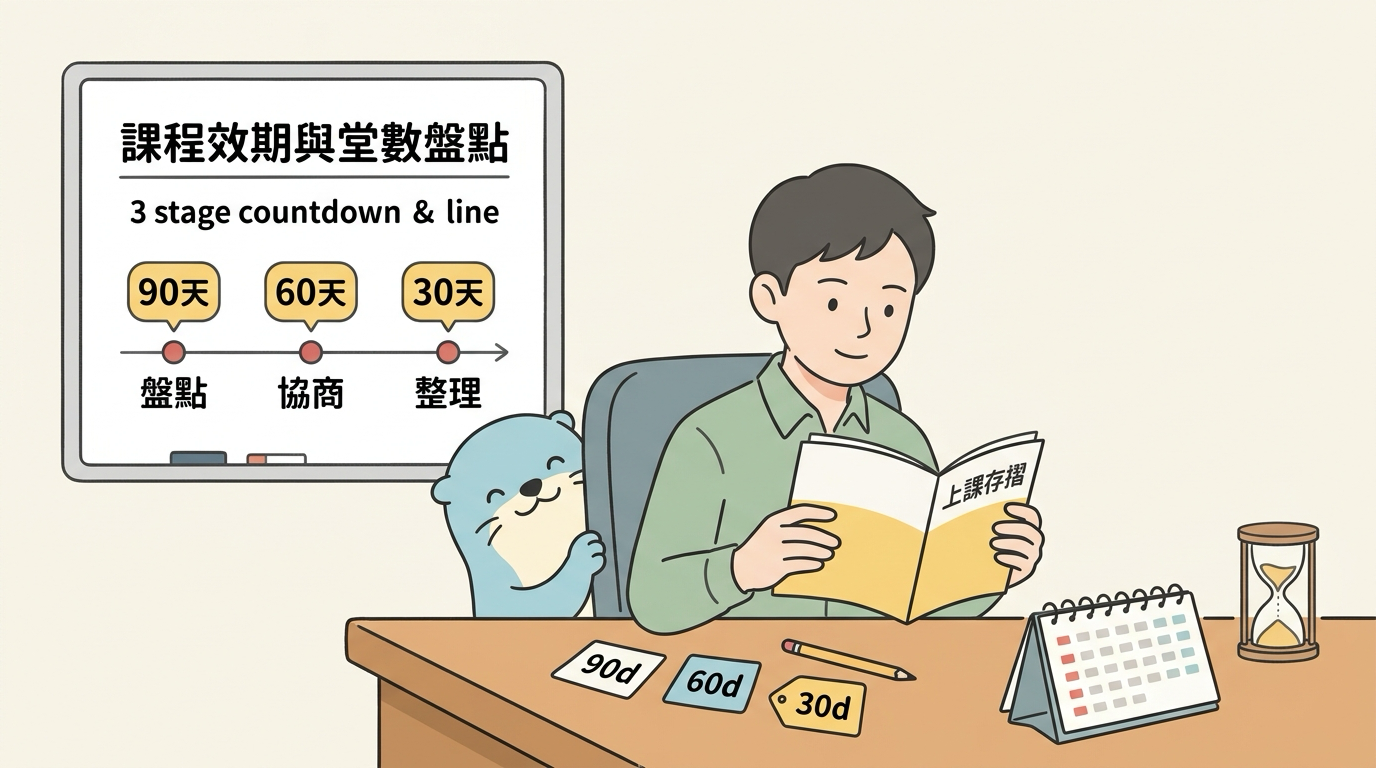
Key Takeaway
When a package is nearing its cutoff date, don't start by guessing your refund. Start by auditing three things: remaining sessions, the official contract end date, and the time you realistically have free each week.
Then work a 30/60/90-day plan: capacity at 90 days, terms at 60 days, documentation at 30 days. Sort out extensions, freezes, transfers, or refunds with the studio and keep the paper trail.
In This Article
What should you do when your prepaid lessons are about to expire? Don't start by guessing your refund. Audit three things first: remaining sessions, your official contract end date, and the time you realistically have free each week. Then work a 30/60/90-day plan (capacity at 90 days, terms at 60 days, documentation at 30 days) to sort out extensions, freezes, transfers, or refunds with the studio while keeping a clear paper trail.
Most people notice in the last week, when a calendar reminds them of the unused fitness sessions, training credits, yoga passes, or tutoring hours still sitting there. Packages get bought on the assumption that life cooperates. Then come overtime, trips, illness, family duties, and fully booked peak slots, and the sessions slip toward the cutoff date.
Arguing from memory or guessing at cancellation fees gets you nowhere. The calmer approach is a ledger both sides can verify line by line, then a negotiation at each countdown milestone.
When Your Package Is Expiring, Check These 3 Numbers First
Before you contact the studio, pull out the receipt, contract, or booking chat history and put these three numbers side by side:
- Remaining Sessions
Unused credits in the system or on your punch card, with paid sessions listed separately from bonus sessions.
- Expiry Date
The final cutoff date in your plan, contract, or account profile.
- Available Time Before Expiry
After work, travel, and personal life, the hours each week you can actually attend class.
Hold multiple packages at one gym or studio? List them together. Seeing sessions, unused value, and expiry dates side by side shows which is most urgent, so high-ticket lessons don't expire unnoticed.
5 Core Concepts to Understand Before You Take Action
Speaking the same language as the business prevents most disputes. Five terms to pin down:
- Remaining Lessons / Unused Credits
Sessions you bought or received that you have not completed yet.
- Contract Expiry Date
The deadline in your contract or account portal. Check whether it runs from the purchase date or your first session.
- Weekly Available Capacity
Time you can realistically give to lessons each week after work, commute, and recovery.
- Equivalent Unused Value
Total price paid divided by purchased sessions, multiplied by remaining paid credits. A budgeting figure, not a guaranteed refund.
- Course Tracker / Lesson Passbook
Your own ledger of payments, lesson dates, session notes, deductions, and remaining credits.
Calculate Your Weekly Requirement: The Time Capacity Formula
Before stressing over extensions, check whether you can finish the package on your own:
[Weekly Lessons Needed Before Expiry]
= Remaining Sessions ÷ Remaining Weeks
A planning example (for scheduling illustration only, not a legal term): 8 personal training sessions left, 4 weeks until the official expiry date.
8 sessions ÷ 4 weeks = 2 sessions per week
That number is a reality check. Can your schedule and energy handle 2 sessions a week? Does the studio open 2 slots that fit your routine? If 1 a week is your ceiling, 4 credits will be left when the clock runs out, so request adjustments now, not in the final week.
How to Handle 90, 60, and 30 Days Out: The 3-Stage Countdown Process
The earlier you act, the more flexibility you get. All three stages follow one principle: confirm the facts, get verbal answers in writing, leave a trail you can point back to.
| Time to Expiry | Phase Goal | Primary Objective | Records to Keep |
|---|---|---|---|
| 90+ Days | Audit & Capacity Check | Audit remaining credits, match against weekly schedule, set up a course tracker | Receipts, total credit breakdown, weekly free time, date of last session |
| ~60 Days | Scheduling & Terms Check | Book sessions actively; if slots are unavailable, confirm adjustment terms in writing | Booking screenshots, leave policies, extension or freeze requirements |
| <30 Days | Evidence & Final Resolution | Resolve discrepancies and formally finalize the remaining credit solution | Complete session ledger, contract terms, written messages, refund calculations |
90+ Days Out: Audit Your Capacity and Time Budget
With three months or more left, you are in full control. This phase is pure auditing:
- Session Structure: How many remaining credits are paid versus complimentary bonus sessions.
- Start Date Rules: Whether the expiry clock started on the purchase date, the payment date, or your first class.
- Your Schedule: Whether the next 12 weeks can absorb the sessions.
- Booking Difficulty: Whether your instructor or preferred slot needs reserving 7 to 14 days ahead.
- Multiple Packages: With group passes and one-on-one sessions at one studio, decide which goes first.
One class a week with 20 left is a gap, not a schedule. Spotting it three months out leaves time to adjust pace or ask about a transfer or extension.
Around 60 Days Out: Turn Verbal Agreements into Written Confirmations
If your current pace won't finish the package, shift from routine booking to confirming policies:
- Session Balances: Message the studio to confirm your count matches their system.
- Cancellation and Makeup Policies: Whether a late cancellation costs a credit, and how makeups work.
- Extension and Freeze Options: What proof is required (medical notes, travel orders, flight tickets), what the limits are, and whether a fee applies.
- Bonus Session Rules: Whether bonus sessions extend with the contract or expire on the original date.
- Substitutes or Service Swaps: If your coach leaves or their schedule stops matching yours, whether another instructor can take over or credits can move elsewhere.
A Key Rule for Communication: If staff said "don't worry, we'll extend it," get that in writing by text or email now. It isn't confrontational. It gives both sides a reference they can check.
Less Than 30 Days Out: Organize Your Records and Finalize Next Steps
In the final 30 days, stop waiting and gather the full paper trail:
- Proof of Payment: Bank transfer slips, credit card statements, paper or electronic receipts.
- Agreements and Terms: Signed contracts, registration forms, screenshots of official package rules.
- Attendance History: Sign-in sheets, app logs, chat screenshots of bookings and cancellations.
- Balance Comparisons: Any difference between your tracker and the studio's system.
- Communication Log: Messages about rescheduling, leave, or slots the studio could not provide.
Then contact the studio in a calm, professional tone: "I currently have [X] unused sessions. Due to [specific reason], completing them within 30 days will be difficult. I'd like to confirm the options under our agreement, such as an extension, transferring the remaining credits, or a refund for the unused portion."
Legal and Regulatory Note: Refund eligibility, calculations, and fee caps depend on your industry and local consumer protection laws. Gyms and personal training packages often fall under fitness center regulations; tutoring centers follow local educational refund standards. In a dispute, check current regulatory guidelines, not unverified advice online.
4 Common Scenarios: Decision Matrix for Expiring Lessons
Situations differ, and so does the right next move. Use this matrix:
| Scenario | Core Issue | Best Action Strategy | Key Follow-Up |
|---|---|---|---|
| Few sessions left, plenty of time (e.g., 2 sessions left, 2 months to go) | Easy to procrastinate and scramble during the final week | Book the 2 sessions on your calendar immediately and get confirmation from the studio | Attend the sessions, sign off on deductions, and close out cleanly |
| Many sessions left, schedule is packed (e.g., 15 sessions left, 6 weeks to go) | Weekly capacity cannot handle the volume; credits will expire | Calculate the capacity gap and apply for an extension, freeze, or transfer 60 days early | Get written confirmation of the new extension date |
| Record discrepancy (e.g., you count 5 sessions left, studio system shows 2) | Disagreements over cancellations, missed check-ins, or system errors | Pull out your course tracker and chat history, reviewing dates line by line with the studio | Clarify which sessions were deducted and why, reaching a clear mutual agreement |
| Studio pitches renewal while old package is unfinished | Sunk cost fallacy and over-purchasing lead to a growing backlog of unused credits | Pause the renewal; calculate your current unused value and required time before committing | Focus on finishing existing credits first; avoid stacking long-term contracts blindly |
What to Track in a Course Tracker: 5 Essential Fields
For a one-glance audit, a tracker needs at least these five fields:
- Provider and Package Name
Studio, branch, and the exact package purchased.
- Purchase Date and Total Paid
Transaction date and amount paid, with receipts saved.
- Session Breakdown
Paid, bonus, and total promised sessions, listed separately.
- Activation and Expiry Dates
When the package became active and when it ends.
- Completed vs. Remaining Sessions
Updated after every class, along with the date you last attended.
Full column list, formulas, and a template: How to Build a Lesson Tracking Spreadsheet: 6 Core Columns and Formulas. Choosing a tool: What Is Lesson Credit Management?
Frequently Asked Questions (FAQ)
If my lessons expire without being used, can I get an immediate refund?
How far in advance should I reach out to the studio?
Can lesson packages be extended or frozen?
Can I keep my promotional bonus sessions after the package expires?
Can a personal course tracker replace an official contract?
Conclusion: The Earlier You Spot Expiring Credits, the More Options You Have
When a package nears its expiry date, stop asking whether you can get a refund and answer three questions instead:
How many sessions do I have left? How many weeks are left before the deadline? Can my weekly routine realistically handle this pace?
Those three numbers reveal the real issue: book more consistently, request an extension, or end the package cleanly. Use 90 days out to audit capacity, 60 days out to confirm terms in writing, and the final 30 days to resolve credits on documentation.
To keep payments, completed classes, remaining credits, and expiry dates in one place, try the Course Kit Lesson Tracker.
References
- Course Kit Lesson Tracker
- Course Kit: Lesson Tracking and Consumer Expense Management
- Executive Yuan Consumer Protection Committee: Consumer Regulations for Tutoring Centers and Fitness Centers
- Course Kit: What Is Lesson Credit Management? A Complete Guide from LINE and Excel to Dedicated Apps
- Course Kit: How to Build a Lesson Tracking Spreadsheet: 6 Core Columns and Formulas
- Course Kit: How Personal Trainers Should Package Sessions: Calculate Delivery Capacity Before Selling 12 or 24 Sessions