Key Takeaway
A personal trainer cancellation policy should clearly explain notice windows, reasons for canceling, late arrivals, no-shows, make-up sessions, backup plans when a trainer cancels, and how every change is logged. Share these rules before accepting payment.
In This Article
- What should you include in a session cancellation policy?
- Should you separate client cancellations into three different situations?
- What backup plans should your policy offer when a trainer cancels?
- How do you write a cancellation policy that protects both sides?
- How do make-up sessions count? Separate expiry dates from session counts
- How should you handle late arrivals, early departures, and no-shows?
- A personal trainer cancellation policy template you can copy
- Where should you put your policy so clients can see it?
- How does the Lesson Passbook track cancellations and make-up sessions?
- FAQ
- Conclusion: Clear rules keep you from relying on memory
A client might have something come up right before a session. A trainer might also need to reschedule due to illness, venue problems, or a calendar conflict.
What usually causes friction is not the cancellation itself. It is trying to figure out what to do after the fact: Does this count as a cancellation? Do we deduct a session? Can the client book a make-up session?
A fair policy does not mean applying the exact same rule to every situation.
Same situation, same outcome. If the reason is different, say how the outcome differs.
What should you include in a session cancellation policy?
A practical cancellation policy should cover at least these items:
- Session and booking times.
- Who can request a cancellation or reschedule.
- Communication channels and valid notice windows.
- Clear definitions for advance cancellations, late cancellations, and no-shows.
- Alternative options when a trainer cancels.
- What happens when a client cancels: a make-up session, a deducted session, or an extension.
- Rules for late arrivals, early departures, and connection issues.
- Make-up session deadlines and booking methods.
- How special circumstances are confirmed.
- What records to keep for every change.
That is the skeleton of your policy. That does not mean every type of training must use the exact same time limits or deductions.
For example, 1-on-1 personal training, small group yoga classes, and online language lessons have different scheduling limits. Your policy needs to match your actual service format so both sides can follow it.
Should you separate client cancellations into three different situations?
We recommend defining them separately.
If you file everything under canceled, you will end up applying one vague rule to completely different situations.
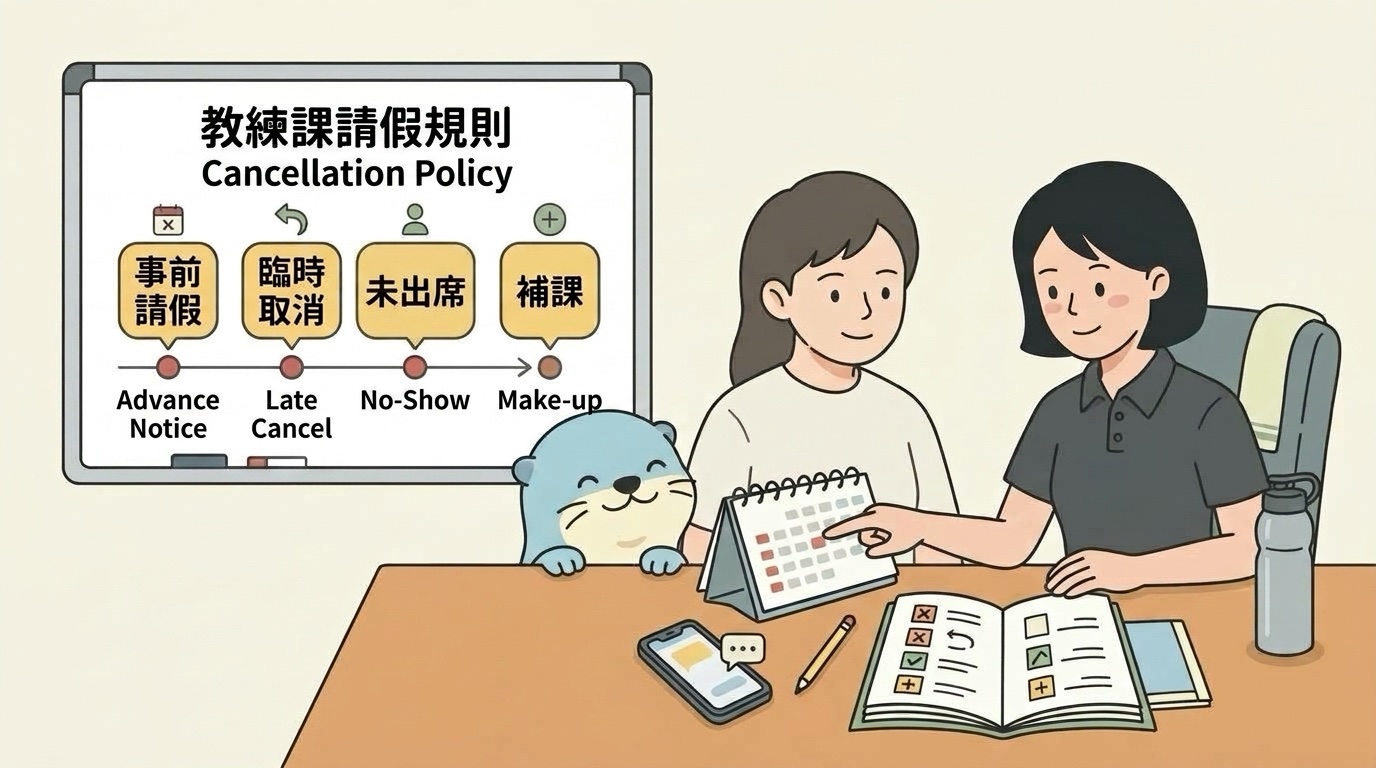
Advance cancellations
An advance cancellation happens before the booked time. The client knows they cannot attend and has enough time to give notice.
Your policy can explain:
- Which channel to use for notice.
- Whether the client keeps the session.
- Whether they can reschedule to another time slot.
- The deadline to complete the reschedule.
- What happens if no new time slot works.
Late cancellations
A late cancellation happens when a client gives notice very close to the session start time.
Here is what to consider together:
- How much time is left before the session starts.
- Whether the trainer already reserved that entire time block.
- Whether venue rental, travel, or prep costs have already been incurred.
- Whether open slots exist for a make-up session.
- Which published policy rule applies to this cancellation.
No-shows
A no-show happens when the scheduled time arrives, the client does not show up, and they gave no advance notice.
Your policy can outline:
- Whether the client reached out after the session started.
- Whether the trainer was on site or in the online room.
- Whether the full time slot was reserved.
- Whether rescheduling is still allowed.
- How sessions, make-ups, and expiry dates are logged.
These three situations can have different outcomes, but you should explain them before payment, not invent rules on the spot.
What backup plans should your policy offer when a trainer cancels?
When a trainer cancels, the policy should not just say "we will figure it out later."
Clients need to know what happens to the sessions they paid for and the time they blocked out.
Depending on your service model, trainers can offer:
- Rescheduling to the next available slot.
- A substitute trainer you told clients about up front, with the same specialty.
- Keeping the session and adjusting its expiry date.
- Agreeing with the client whether that session still gets deducted.
- If you cannot deliver the service at all, follow your contract or whatever you both confirm in writing.
Keep trainer cancellations separate from client cancellations.
A trainer being unable to provide the service is not the same as a client changing their plans. Grouping both into one generic paragraph leaves clients confused about how their sessions are handled.
How do you write a cancellation policy that protects both sides?
You can check your policy from four angles:
| Perspective | Questions to confirm |
|---|---|
| Upfront clarity | Can the client see the full policy before paying? |
| Covers both sides | Does the policy cover both trainer and client cancellations? |
| Realistic process | Are the make-up slots, deadlines, and booking steps truly workable? |
| Consistent logs | Do both parties share the same record for every cancel, reschedule, and deducted session? |
Fair does not mean every situation gets the exact same outcome.
For example, asking to reschedule ahead of time is different from not showing up at all. A trainer canceling for any reason may also need to offer a separate backup plan.
The important part is writing down these differences and sharing them with clients before they pay.
How do make-up sessions count? Separate expiry dates from session counts
Confusion around make-up sessions usually comes down to three questions:
- Does a make-up session use the original session, or does it add a new one?
- Does the make-up deadline match the original package expiry date?
- If a client reschedules a make-up session and cancels again, do the same rules apply?
Track these details separately:
- Original session date.
- Cancellation or reschedule date.
- Time the cancellation was submitted.
- Original deduction status.
- Make-up session date.
- Deduction status after the make-up session is completed.
- Where to find the related messages or payment records.
For example, a session booked for October 8 is moved to October 15. The record should keep the original date, the reason for rescheduling, the notice time, and the new session date.
When you reconcile your records at the end of the month, it is easy to see whether that session was rescheduled, made up, or completed.
To explore different tracking setups, check out What Is Lesson Credit Management? From Chat Threads to a Dedicated App or read How to Build a Lesson Tracking Spreadsheet: Six Columns and Two Formulas.
How should you handle late arrivals, early departures, and no-shows?
Late arrivals, early departures, and no-shows affect session time differently. Avoid cramming them into a single rule.
Late arrivals
The client or trainer arrives late, but the session can still take place.
Your policy can state:
- Whether the session still ends at the scheduled time.
- Whether the content will adjust to the remaining time.
- Who logs the late arrival.
- How long you will wait for reconnections during online sessions.
Early departures
The session starts on time, but the client leaves early.
Say whether the leftover time is lost or can be made up. This depends on your service format and original policy; do not assume one rule fits every business.
No-shows
The client does not check in during the scheduled time and gave no advance notice.
State whether the trainer had already arrived or opened the online room, and how follow-up notes and sessions will be handled.
Do not make "10 minutes late" a blanket rule for everything.
Ten minutes means something very different in a 30-minute online consult compared to a 2-hour in-person session. Set time limits and policies based on session length, service format, and how you book.
A personal trainer cancellation policy template you can copy
Here is a flexible policy template without fixed hours or dollar amounts.
Fill in the brackets based on your setup, then paste it into your package pages, service contracts, or booking confirmations.
Session Cancellation and Rescheduling Policy
- Once booked, please send any cancellation or rescheduling requests through [designated channel].
- We define advance cancellations, late cancellations, and no-shows by [notice window / service format].
- If you cancel, whether you can make up the session, keep it, or use it by the original expiry date depends on [package terms].
- If your trainer cancels, you'll be offered [rescheduling / substitute trainer / keep session / other arrangements].
- Late arrivals, early departures, and connection issues follow [specific terms].
- We will log every change, including [date, reason, notice time, original session status, and next steps].
- For any special cases not listed here, we will agree on the plan in writing before updating your records.
Make sure to fill in all the brackets before using this policy.
Leaving terms like "handled case by case" or "we will figure it out later" might seem flexible, but it forces you to renegotiate every single time an issue happens.
Where should you put your policy so clients can see it?
If your policy only lives in your private notebook, clients cannot check it before paying.
Consider placing it in these spots:
- On your package page or quote before payment.
- In contracts, terms of service, or booking confirmation documents.
- In your session log and in every schedule-change message after payment.
If you update your policy later, list the effective date and specify which active packages it applies to so old and new terms do not get mixed up.
To review cancellation, reschedule, and refund terms before purchasing, you can also check out the Course Buying Checklist.
This article offers a framework for organizing policies. It does not determine refund eligibility for individual cases, nor does it prescribe a single rule for every service type.
How does the Lesson Passbook track cancellations and make-up sessions?
Once your policy is written, you need an ongoing way to track session records.
In the Lesson Passbook's lesson log sheet, you log the course name, date, and sessions used after every session. The overview sheet automatically calculates your sessions left and days until expiry. It is not a contract, and it cannot replace formal service policies or payment records.
You can record schedule changes like cancellations, reschedules, and make-up sessions in the notes column for that entry, including:
- Reason for cancellation or rescheduling.
- Notice time.
- Whether a session was deducted this time.
- Make-up session date.
- Whether the expiry date changed.
- Where related messages or receipts are kept.
This way, when both sides look back weeks later, they can still see what happened with a particular change.
If you want to track notice times, session deduction status, and make-up arrangements in one place starting from your next cancellation, check out the Lesson Passbook.
FAQ
How do you write a personal trainer cancellation policy?
Do you have to deduct a session for a client's late cancellation?
What happens to a client session when a trainer cancels?
How should you log a client no-show?
Can you update cancellation rules after a client pays?
Conclusion: Clear rules keep you from relying on memory
Canceling a session is not necessarily a problem.
The real issue starts when you lack a shared policy and clear records, turning every change into a new negotiation.
A fair personal trainer cancellation policy covers both the trainer and the client. It also tracks notice windows, service costs, make-up session plans, and session balances separately.
Your policy explains the rules, while your records track what actually happened. When you keep both in order, you will not have to rely on memory the next time someone needs to reschedule.
If you want to keep every session, deduction, cancellation, and make-up plan in the same place, try the Lesson Passbook.
Starting from your next cancellation, keep notice times, deduction statuses, and make-up plans in the same Lesson Passbook so both sides can more easily refer back to the same version later.
References and limitations
- Course Kit Lesson Passbook
- Course Kit Course Buying Checklist
- What Is Lesson Credit Management? From Chat Threads to a Dedicated App
- How to Build a Lesson Tracking Spreadsheet: Six Columns and Two Formulas
This article outlines a framework for managing cancellation, rescheduling, and session tracking policies. It does not imply that every trainer, gym, studio, or online tutor should use the exact same terms. Actual session deductions, make-up sessions, extensions, and refund terms must align with individual packages, contracts, payment records, service types, and applicable regulations.

We turn the course-tracking questions people ask us into articles. Course Kit is an app for tracking prepaid session packages, where the manager and the member open it to the same numbers.